

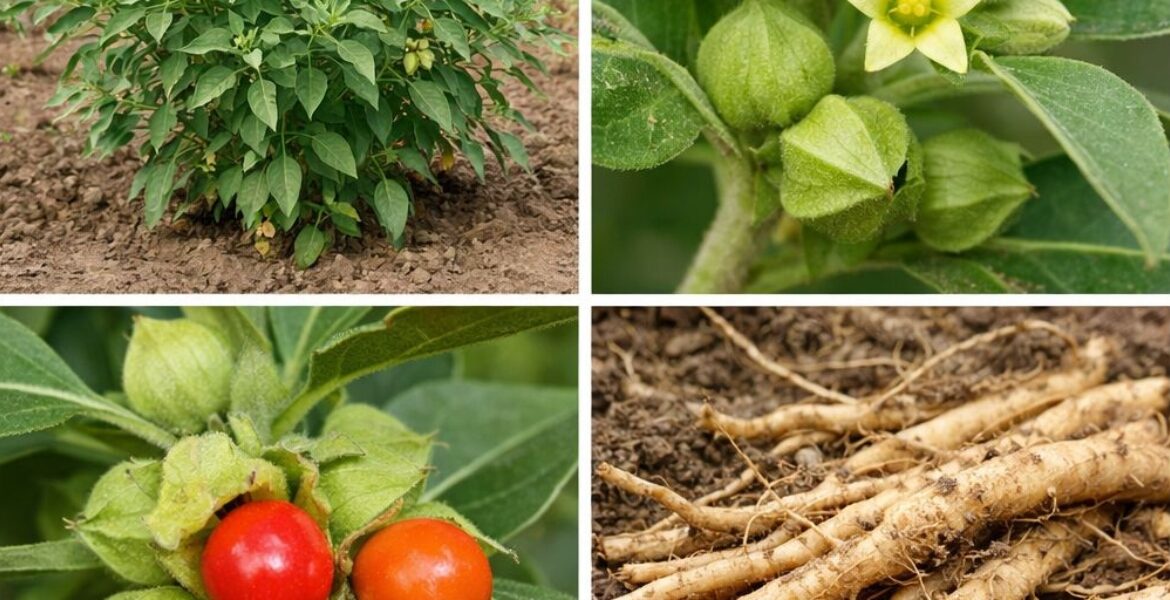
1. Introduction to Ashwagandha Farming
Ashwagandha (Withania somnifera), commonly known as Indian Ginseng or Winter Cherry, is one of India’s most valuable medicinal plants. This ancient herb holds a prestigious place in Ayurvedic medicine and has gained global recognition for its therapeutic properties. Ashwagandha farming in India has emerged as a highly profitable venture for farmers seeking alternatives to traditional crops.
What is Ashwagandha (Withania somnifera)?
Ashwagandha is a small shrub belonging to the Solanaceae family, characterized by its yellow flowers and red berries. The plant’s roots contain active compounds called withanolides, which are responsible for its powerful medicinal properties. The Withania somnifera cultivation process is relatively straightforward, making it accessible to both new and experienced farmers.
Importance of Ashwagandha Cultivation in India
India is the world’s largest producer and exporter of Ashwagandha, with major cultivation happening in:
- Madhya Pradesh (largest producer)
- Rajasthan
- Gujarat
- Punjab
- Haryana
- Uttar Pradesh
The growing global demand for herbal supplements and natural medicines has positioned Ashwagandha crop benefits at the forefront of medicinal plant farming India initiatives.
Key Health and Medicinal Benefits Making it Profitable
The commercial success of Ashwagandha stems from its extensive therapeutic applications:
- Stress and Anxiety Relief: Powerful adaptogenic properties that help manage cortisol levels
- Immune System Support: Enhances body’s natural defense mechanisms
- Energy and Vitality: Improves stamina and reduces fatigue
- Cognitive Enhancement: Supports memory, focus, and mental clarity
- Anti-inflammatory Properties: Reduces inflammation and supports joint health
- Hormonal Balance: Particularly beneficial for thyroid and reproductive health
- Sleep Quality: Promotes better sleep patterns
The pharmaceutical, nutraceutical, and cosmetic industries’ increasing demand for Ashwagandha has created stable market opportunities, making it one of the most profitable crops for Indian farmers.
2. Climate and Soil Requirements
Understanding the optimal growing conditions is crucial for successful Ashwagandha farming in India. This hardy plant thrives in specific environmental conditions that farmers must replicate for maximum yields.
Best Climatic Conditions for Ashwagandha
Ashwagandha is naturally adapted to dry and subtropical regions:
| Climate Parameter | Optimal Range | Details |
|---|---|---|
| Temperature | 20°C to 38°C | Tolerates temperatures up to 40°C; sensitive to frost |
| Rainfall | 500-750 mm annually | Prefers dry conditions; excess moisture causes root rot |
| Humidity | Low to Moderate | High humidity increases disease susceptibility |
| Altitude | Up to 1500 meters | Grows well in plains and low hills |
| Sunshine | Full sun exposure | Requires 6-8 hours of direct sunlight daily |
| Growing Season | Dry season preferred | October-November sowing ideal in most regions |
Key Climate Considerations:
- Ashwagandha performs best in dry tropical and subtropical climates
- Requires well-distributed but limited rainfall during growing period
- Cannot tolerate waterlogging or prolonged wet conditions
- Winter season (Rabi crop) cultivation is most successful
- Tolerates drought conditions once established
Soil Type Preferences
| Soil Characteristic | Ideal Specification |
|---|---|
| Soil Type | Sandy loam, loamy, red soil |
| pH Range | 7.5 to 8.0 (slightly alkaline) |
| Drainage | Excellent drainage essential |
| Organic Matter | Moderate (2-3%) |
| Soil Depth | Minimum 45-60 cm for root development |
| Salinity Tolerance | Moderate salt tolerance |
Soil Preparation Tips:
- Avoid heavy clay soils that retain excessive moisture
- Well-drained sandy loam soils produce the best root quality
- Soil should be loose and friable to allow easy root penetration
- Red and black soils with good drainage also suitable
- Slightly alkaline pH favors withanolide content in roots
Ideal Regions in India for Cultivation
Top Ashwagandha Growing States:
- Madhya Pradesh – Accounts for 40% of national production
- Districts: Mandsaur, Neemuch, Ratlam
- Rajasthan – Major producer of high-quality roots
- Districts: Jhalawar, Kota, Nagaur, Jodhpur
- Gujarat – Growing cultivation area
- Districts: Patan, Mehsana, Banaskantha
- Punjab and Haryana – Emerging cultivation zones
- Suitable for farmers transitioning from wheat-paddy rotation
- Uttar Pradesh – Traditional growing regions
- Districts: Bareilly, Aligarh
- Maharashtra – Dry regions suitable for cultivation
- Marathwada and Vidarbha regions
The semi-arid and arid zones of these states provide the ideal combination of climate and soil conditions for commercial Ashwagandha cultivation.
3. Land Preparation and Seed Selection
Proper land preparation and quality seed selection are foundational steps that significantly impact the success of your Withania somnifera cultivation venture.
Steps for Land Preparation
Pre-Planting Land Preparation:
- Field Selection
- Choose well-drained fields with no history of waterlogging
- Avoid fields previously affected by root diseases
- Prefer fields with southern or western exposure for maximum sunlight
- Primary Tillage
- Conduct deep ploughing (20-25 cm depth) during summer months
- This helps in soil aeration and destroys pest/disease residues
- Allow soil to weather under sun for 15-20 days
- Soil Treatment
- Apply 8-10 tonnes of well-decomposed farmyard manure (FYM) per hectare
- Mix thoroughly with soil 3-4 weeks before sowing
- For organic farming, use vermicompost (5 tonnes/hectare)
- Secondary Tillage
- Conduct 2-3 cross ploughings with cultivator
- Break all clods to create fine tilth
- Level the field properly using a leveler
- Bed/Ridge Formation
- Create raised beds (15 cm height) in areas with potential drainage issues
- Form ridges and furrows for irrigation management
- Ensure proper slope for water drainage
- Pre-Sowing Irrigation
- Apply light irrigation 7-10 days before sowing if soil is dry
- Allows proper seed germination and establishment
Best Seed Varieties for High Yield
Selecting the right variety is crucial for maximizing profitability in Ashwagandha farming in India.
Top Ashwagandha Seed Varieties India:
| Variety Name | Developed By | Key Features | Yield Potential |
|---|---|---|---|
| Poshita | CIMAP, Lucknow | High withanolide content (0.45-0.6%), uniform root size | 500-600 kg/ha (dry roots) |
| Jawahar Asgandh-20 | JNKVV, Jabalpur | Drought tolerant, suitable for rainfed conditions | 450-550 kg/ha |
| Jawahar Asgandh-134 | JNKVV, Jabalpur | Early maturing (150-160 days), disease resistant | 500-600 kg/ha |
| WS-20 | RAU, Rajasthan | Adapted to arid zones, high alkaloid content | 400-500 kg/ha |
| Arka Ashwagandha | IIHR, Bangalore | Suitable for varied climatic conditions | 450-500 kg/ha |
| Local Selections | State Agricultural Universities | Region-specific adaptations | Variable (350-500 kg/ha) |
Seed Quality Characteristics:
- Seed germination rate: Minimum 70-80%
- Seed purity: 98% minimum
- Physical purity: Free from other crop seeds and inert matter
- Fresh seeds (less than 1 year old) recommended
- Store seeds in cool, dry conditions before sowing
Seed Requirement:
- 10-12 kg of seeds per hectare for direct sowing
- 4-5 kg of seeds for nursery raising (sufficient for 1 hectare transplanting)
Sowing Methods:
Method 1: Direct Sowing (Most Common)
Advantages: Simple, cost-effective, no transplanting shock
Process:
- Sowing Time: October-November (Rabi season) or June-July (Kharif season)
- Sowing Depth: 1-2 cm deep
- Method: Line sowing in rows using seed drill or manual dibbling
- Spacing:
- Row to row: 30 cm (20-25 cm for higher density)
- Plant to plant: 10 cm initially
- Thinning: After 25-30 days, maintain 15-20 cm plant spacing
- Seed Rate: 10-12 kg/hectare
Method 2: Nursery Transplanting
Advantages: Better plant uniformity, easier weed management initially, higher survival rate
Process:
- Nursery Preparation:
- Raise nursery in small beds (3m × 1m × 15cm)
- Use mixture of soil, FYM, and sand (2:1:1 ratio)
- Sow seeds in lines 5 cm apart
- Apply light irrigation daily
- Seedling Management:
- Germination occurs in 6-8 days
- Ready for transplanting in 30-40 days (4-5 leaf stage)
- Seedling height: 10-15 cm
- Transplanting:
- Transplant in evening hours to reduce stress
- Transplanting spacing: 30 cm × 20 cm or 45 cm × 15 cm
- Water immediately after transplanting
- Maintain 80-85% plant stand
Sowing Calendar for Different Regions:
| Region | Preferred Sowing Time | Harvest Time |
|---|---|---|
| North India | October-November | April-May (180-200 days) |
| Central India | October-November | April-May |
| South India | June-July or October-November | February-March or May-June |
| Western India | October-November | March-April |
Post-Sowing Care:
- Apply light irrigation immediately after sowing
- Ensure soil moisture during germination period (10-15 days)
- Monitor for ant and termite attacks in initial stages
- Maintain weed-free conditions in first 30 days
4. Cultivation Practices
Implementing proper cultivation practices is essential for achieving optimal yields and quality in Ashwagandha farming in India. This section covers the complete agronomic management required throughout the growing season.
Spacing, Planting Depth, and Crop Calendar
Recommended Spacing Systems:
| Planting System | Row Spacing | Plant Spacing | Plant Population/Ha | Best For |
|---|---|---|---|---|
| Standard System | 30 cm | 20 cm | 166,000 plants | Balanced yield and root quality |
| Wide Spacing | 45 cm | 20 cm | 111,000 plants | Better root size, easier management |
| High Density | 30 cm | 10 cm | 333,000 plants | Maximum yield (requires more inputs) |
| Paired Row System | 45-30-45 cm | 15 cm | 150,000 plants | Better light and air circulation |
Planting Depth Guidelines:
- Seed sowing depth: 1.5-2 cm (shallow sowing)
- Transplanting depth: Seedlings planted at same depth as nursery
- Avoid deep sowing: Reduces germination percentage
Complete Crop Calendar:
| Days After Sowing | Growth Stage | Management Activities |
|---|---|---|
| 0-10 days | Germination | Light irrigation every 2-3 days, monitor seed germination |
| 10-30 days | Seedling establishment | Weed control, gap filling, thinning (if direct sown) |
| 30-60 days | Vegetative growth | First fertilizer application, irrigation as needed |
| 60-90 days | Branch development | Second fertilizer dose, pest monitoring begins |
| 90-120 days | Flowering initiation | Reduced irrigation, maintain weed control |
| 120-150 days | Flowering and fruiting | Minimal irrigation, pest and disease vigilance |
| 150-180 days | Root maturity | Stop irrigation 15-20 days before harvest |
| 180-210 days | Harvest readiness | Harvest when leaves start yellowing and drying |
Fertilizer Recommendations and Organic Options
Conventional Fertilizer Schedule:
Basal Application (At sowing/transplanting):
- Farmyard Manure (FYM): 10-15 tonnes/hectare (mixed during land preparation)
- Nitrogen (N): 20 kg/hectare
- Phosphorus (P₂O₅): 30-40 kg/hectare
- Potassium (K₂O): 20 kg/hectare
Chemical Fertilizer Equivalents:
- Urea: 45 kg/hectare (provides 20 kg N)
- Single Super Phosphate (SSP): 190 kg/hectare or DAP: 65 kg/hectare
- Muriate of Potash (MOP): 35 kg/hectare
Top Dressing (Split application):
- First top dressing (30-35 days after sowing):
- Nitrogen: 10 kg/hectare (22 kg Urea)
- Apply after first weeding and light irrigation
- Second top dressing (60-70 days after sowing):
- Nitrogen: 10 kg/hectare (22 kg Urea)
- Apply before flowering stage
Organic Fertilizer Options:
For organic Ashwagandha cultivation and sustainable farming:
| Organic Input | Application Rate | Application Time | Benefits |
|---|---|---|---|
| Vermicompost | 5-6 tonnes/ha | Basal application | Rich in nutrients, improves soil structure |
| Neem Cake | 500 kg/ha | Basal application | Provides nitrogen, acts as pest repellent |
| Bone Meal | 300-400 kg/ha | Basal application | Excellent phosphorus source |
| Wood Ash | 200 kg/ha | Basal application | Provides potassium and micronutrients |
| Compost | 8-10 tonnes/ha | Basal application | Improves soil organic matter |
| Biofertilizers | 4-5 kg/ha | Seed treatment + soil | Enhances nutrient availability |
Micronutrient Application:
- Zinc Sulphate: 25 kg/hectare (especially in deficient soils)
- Foliar spray of micronutrient mixture at 60 and 90 days after sowing
- Iron and Manganese supplement in alkaline soils
Organic Foliar Nutrition:
- Panchagavya: 3% solution spray at 45, 75, and 105 days
- Vermiwash: Diluted 1:10, sprayed fortnightly
- Seaweed extract: 2-3 ml/liter water, 2-3 sprays during growing season
Water Management and Irrigation Practices
Ashwagandha requires moderate and carefully managed irrigation. Over-watering is the most common cause of crop failure.
Critical Water Management Principles:
✓ Ashwagandha prefers dry conditions – “less water is better than more”
✓ Avoid waterlogging at all costs – causes root rot
✓ Reduce irrigation during root development phase
✓ Stop irrigation 15-20 days before harvest for better root quality
Irrigation Schedule:
| Growth Stage | Irrigation Frequency | Irrigation Method | Special Notes |
|---|---|---|---|
| Germination (0-10 days) | Every 2-3 days (light) | Sprinkler preferred | Keep soil surface moist |
| Establishment (10-45 days) | Every 5-7 days | Furrow or drip | Critical period for plant stand |
| Vegetative growth (45-90 days) | Every 10-12 days | Furrow or drip | Moderate moisture sufficient |
| Flowering (90-150 days) | Every 15-20 days | Drip recommended | Reduce water gradually |
| Root maturity (150+ days) | Minimal/stop irrigation | – | Stop 15-20 days before harvest |
Irrigation Methods Comparison:
- Furrow Irrigation (Most Common)
- Water applied through furrows between ridges
- Cost-effective for small farmers
- Water requirement: 350-400 mm total
- Requires 4-6 irrigations in entire crop season
- Drip Irrigation (Best for Quality Production)
- Precise water application directly to root zone
- Saves 40-50% water compared to furrow irrigation
- Reduces disease incidence
- Can be combined with fertigation
- Initial investment higher but long-term benefits significant
- Sprinkler Irrigation
- Useful during germination and early stages
- Not recommended during flowering and maturity
- Can increase humidity-related diseases
Rainfall Considerations:
- In rainfed conditions, supplementary irrigation required only if rainfall < 500 mm
- Excess rainfall during crop period is detrimental
- Ensure proper drainage channels to remove excess water quickly
Weed and Pest Control Measures
Weed Management:
Weeds compete significantly during early growth stages (first 60 days).
Cultural Weed Control:
- Hand weeding: 2-3 times during crop season
- First weeding: 25-30 days after sowing
- Second weeding: 50-60 days after sowing
- Third weeding (if needed): 80-90 days after sowing
- Intercultivation: Use wheel hoe between rows after each weeding
- Mulching: Apply organic mulch (crop residue) to suppress weeds
Chemical Weed Control:
Pre-emergence herbicides:
- Pendimethalin 30% EC: 3.3 liters/hectare within 2-3 days of sowing
- Spray with 500 liters water per hectare
- Controls annual grasses and some broadleaf weeds
Post-emergence herbicides:
- Quizalofop ethyl 5% EC: 1 liter/hectare at 20-25 days after sowing
- Effective against grass weeds
- Apply when weeds are in 2-4 leaf stage
Organic Weed Management:
- Mulching with straw (5-6 tonnes/hectare)
- Mechanical weeding using cono weeder
- Intercropping with short-duration crops like coriander or fenugreek (in initial stages)
Major Pests and Control:
| Pest | Symptoms | Control Measures |
|---|---|---|
| Root-knot nematode | Galls on roots, stunted growth, yellowing | Soil treatment with neem cake (500 kg/ha); crop rotation; use Carbofuran 3G (33 kg/ha) |
| Leaf webber caterpillar | Leaves webbed together, defoliation | Bacillus thuringiensis (Bt) spray (1-2 g/liter); Chlorpyriphos 20% EC (2 ml/liter) |
| Aphids | Curling of leaves, stunted growth | Neem oil spray (3-5 ml/liter); Imidacloprid 17.8% SL (0.3 ml/liter) |
| Whitefly | Yellowing leaves, sooty mold | Yellow sticky traps; Neem oil spray; Thiamethoxam 25% WG (0.2 g/liter) |
| Root grubs | Wilting plants, root damage | Soil application of neem cake; Chlorpyriphos drench around plant base |
Major Diseases and Control:
| Disease | Symptoms | Control Measures |
|---|---|---|
| Root rot (Fusarium, Rhizoctonia) | Wilting, browning of roots | Avoid waterlogging; treat soil with Trichoderma viride (2.5 kg/ha); seed treatment with Carbendazim |
| Leaf spot (Alternaria) | Brown circular spots on leaves | Remove infected leaves; spray Mancozeb 75% WP (2.5 g/liter) or Carbendazim (1 g/liter) |
| Powdery mildew | White powdery coating on leaves | Sulfur dust (20-25 kg/ha); spray wettable sulfur (2.5 g/liter) |
| Damping off | Seedling collapse at soil level | Soil sterilization in nursery; seed treatment with Thiram; avoid over-watering |
Integrated Pest Management (IPM) Strategy:
- Cultural practices:
- Crop rotation (avoid Solanaceae family crops in previous season)
- Use disease-free seeds
- Maintain proper plant spacing for air circulation
- Remove and destroy infected plant parts
- Biological control:
- Release Trichogramma cards (50,000/ha) for caterpillar control
- Use Trichoderma viride for soil-borne disease management
- Encourage natural predators (ladybird beetles, lacewings)
- Mechanical control:
- Install light traps (1/hectare) for night-flying insects
- Use pheromone traps for monitoring pest population
- Manual collection and destruction of caterpillars
- Organic sprays:
- Neem oil (Azadirachtin 0.15%): 3-5 ml/liter water
- NSKE (Neem Seed Kernel Extract): 5% solution
- Panchagavya: 3% solution for overall plant health
- Cow urine: Fermented, diluted 1:10
- Chemical control (Last resort):
- Use only when pest/disease crosses economic threshold level
- Follow recommended dosages strictly
- Maintain pre-harvest interval (PHI) before harvesting
- Rotate chemicals to prevent resistance development
Monitoring and Scouting:
- Conduct regular field inspections (twice weekly)
- Monitor pest and disease incidence from 30 days after sowing
- Take action when pest population reaches economic threshold
- Keep records of pest/disease occurrences for future reference
5. Growth Cycle, Flowering & Harvesting
Understanding the growth cycle and timing harvest correctly are crucial for maximizing both yield and quality in Ashwagandha farming in India.
Time Taken for Germination and Establishment
Germination Phase (0-15 days):
- Seed germination begins: 5-7 days after sowing (with adequate moisture)
- Complete germination: 10-15 days
- Germination percentage: 70-85% under optimal conditions
- Cotyledon emergence: 7-10 days
- First true leaves: 12-15 days
Factors Affecting Germination:
- Soil temperature: 25-30°C is optimal
- Soil moisture: Consistent but not waterlogged
- Seed quality and freshness
- Sowing depth (should not exceed 2 cm)
Establishment Phase (15-45 days):
- Active vegetative growth begins: 20-25 days
- Plant height reaches: 15-20 cm by 30 days
- Root system development: Primary root penetrates 15-20 cm deep
- Leaf production: 4-6 leaves per plant by 45 days
- Critical period: Most vulnerable to pest attacks and environmental stress
Key Management During Establishment:
- Maintain consistent soil moisture
- First weeding and thinning (if direct sown)
- Gap filling with extra seedlings
- First top dressing of fertilizers (30-35 days)
Duration Until Flowering and Root Maturity
Complete Growth Cycle Timeline:
| Growth Stage | Duration | Visible Characteristics | Management Focus |
|---|---|---|---|
| Germination | 0-15 days | Cotyledon emergence, first leaves | Moisture management, pest monitoring |
| Seedling | 15-30 days | 4-6 leaves, 10-15 cm height | Thinning, first weeding |
| Vegetative growth | 30-90 days | Rapid leaf and branch development, 40-60 cm height | Fertilization, irrigation, weed control |
| Flowering initiation | 90-110 days | Flower bud formation, branching complete | Reduce irrigation frequency |
| Full flowering | 110-140 days | Yellow-green flowers, 60-75 cm height | Pest and disease monitoring |
| Fruiting | 140-160 days | Red berries develop, seed maturation | Minimal irrigation |
| Root maturity | 160-180 days | Leaves yellowing, berry ripening | Stop irrigation, prepare for harvest |
| Harvest ready | 180-210 days | Leaves drying, plant senescing | Harvest within optimal window |
Flowering Characteristics:
- Flower appearance: Small, inconspicuous, yellow-green flowers
- Flowering pattern: Flowers appear in leaf axils (leaf-stem junction)
- Flowering duration: Extends over 30-40 days
- Pollination: Self-pollinated, insect-assisted
- Berry development: Red berries (5-7 mm diameter) containing 10-20 seeds
- Seed maturity: Seeds turn brown when fully mature
Root Development Pattern:
Phase-wise root growth:
- Early phase (0-60 days):
- Tap root establishment (20-30 cm deep)
- Lateral root initiation
- Root diameter: 3-5 mm
- Mid-season (60-120 days):
- Rapid root elongation (40-60 cm deep)
- Secondary root branching
- Root diameter: 5-8 mm
- Root biomass accumulation begins
- Maturity phase (120-180 days):
- Maximum root thickness achieved (8-12 mm)
- Root length: 50-80 cm
- Withanolide accumulation peaks during this phase
- Root bark becomes thick and cork-like
Factors Influencing Root Maturity:
- Variety: Early varieties mature in 150-160 days; late varieties in 180-200 days
- Season: Rabi crop (October sowing) gives better root quality than Kharif
- Soil type: Light soils promote faster, longer root development
- Water stress: Moderate stress during maturity enhances withanolide content
- Temperature: Cooler temperatures (15-25°C) during root maturity improve quality
Best Time and Method to Harvest Ashwagandha Roots
Determining Harvest Readiness:
Visual Indicators:
- ✓ Leaves turn yellow and begin to dry
- ✓ Berries ripen completely (bright red color)
- ✓ Lower leaves drop naturally
- ✓ Plant height stabilizes at 60-80 cm
- ✓ Stems become woody and brittle
Age Indicators:
- Minimum age: 150 days after sowing (for emergency harvest)
- Optimal age: 180-200 days (maximum withanolide content)
- Late harvest risk: Beyond 210 days, roots may become fibrous
Root Quality Indicators:
- Root bark becomes thick and corky
- Root diameter: 8-12 mm at crown
- Root length: 15-25 cm (main root)
- Creamy white to pale brown color inside
- Characteristic pungent aroma when broken
Optimal Harvesting Time:
| Region | Sowing Time | Harvest Period | Crop Duration |
|---|---|---|---|
| North India | October-November | Late March-April | 170-190 days |
| Central India | October-November | Early April-May | 180-200 days |
| South India | June-July | December-January | 170-180 days |
| Western India | October-November | March-April | 170-190 days |
Pre-Harvest Preparation:
- Stop irrigation: 15-20 days before planned harvest
- Allows soil to dry and roots to harden
- Easier uprooting and cleaning
- Better storage quality
- Field assessment:
- Sample 10-15 plants randomly
- Check root maturity and quality
- Ensure at least 80% plants show harvest indicators
- Weather consideration:
- Choose dry weather for harvesting
- Avoid harvesting during or immediately after rain
- Early morning harvest preferred to avoid afternoon heat
Harvesting Methods:
Method 1: Manual Harvesting (Most Common)
Step-by-step process:
- Preparation:
- Select only mature plants
- Have tools ready: spade, fork, or khurpi (hand tool)
- Arrange collection bags/baskets
- Uprooting:
- Dig around the plant (20-25 cm radius, 30 cm deep)
- Loosen soil carefully without breaking roots
- Hold plant stem base and pull gently
- Shake off excess soil
- Separating roots:
- Cut plant stem 2-3 cm above root crown
- Remove lateral roots and root hairs
- Keep main tap root intact
Advantages:
- Selective harvesting possible
- Minimal root damage
- Lower cost for small farms
- Better for uneven maturity
Disadvantages:
- Labor-intensive
- Slower process (0.5-1 acre/day with 4-5 workers)
- Higher labor cost
Method 2: Mechanical Harvesting (For Large Farms)
Equipment used:
- Potato digger (modified)
- Root harvester attachment for tractor
- Deep tillage implements
Process:
- Set equipment depth to 35-40 cm
- Make passes along rows
- Manual collection follows mechanical lifting
- Suitable for uniform maturity crops
Advantages:
- Fast (2-3 acres/day)
- Reduced labor requirement
- Cost-effective for large areas
Disadvantages:
- Higher root breakage (15-20%)
- Initial equipment investment
- Requires uniform plant stand
Yield Expectations at Harvest:
| Component | Fresh Weight | Dry Weight | Market Value |
|---|---|---|---|
| Roots | 1500-2000 kg/ha | 500-700 kg/ha | Primary product |
| Leaves | 800-1000 kg/ha | 200-250 kg/ha | Secondary product |
| Seeds | 50-70 kg/ha | 40-50 kg/ha | Planting material/medicine |
Post-Harvest Handling (Immediate):
- Field sorting:
- Remove damaged, diseased, or insect-infested roots
- Separate roots by size (premium, medium, small)
- Discard very thin roots (<5 mm diameter)
- Temporary storage:
- Keep harvested roots in shade
- Avoid sun exposure immediately after harvest
- Transport to processing area within 6-8 hours
- Cleaning preparation:
- Arrange for washing facility
- Prepare drying areas
- Plan processing schedule
Critical Harvest Tips:
⚠️ Avoid these common mistakes:
- Harvesting before 150 days (immature roots, lower withanolide)
- Harvesting in wet soil (difficult cleaning, poor quality)
- Delaying harvest beyond 210 days (roots become woody and fibrous)
- Breaking roots during harvest (reduces market value)
- Sun-drying roots immediately (darkening, quality loss)
✓ Best practices:
- Harvest in batches if maturity is uneven
- Keep root crown intact (2-3 cm stem portion)
- Handle roots gently to minimize damage
- Process within 24 hours of harvesting for best quality
6. Yield Expectations and Economics
Understanding the financial aspects of Ashwagandha farming in India is essential for farmers to make informed decisions and maximize profitability. This section provides realistic yield expectations and comprehensive economic analysis.
Average Yield Per Hectare in India
Dry Root Yield (Primary Product):
| Cultivation Type | Expected Yield | Conditions |
|---|---|---|
| Rainfed cultivation | 350-450 kg/ha | Minimal inputs, traditional varieties |
| Irrigated with conventional practices | 500-600 kg/ha | Moderate inputs, improved varieties |
| Intensive cultivation | 650-800 kg/ha | High inputs, drip irrigation, improved varieties |
| Organic cultivation | 400-500 kg/ha | Organic inputs, certified practices |
| Experimental/best farms | 800-1000 kg/ha | Research stations, optimal conditions |
Factors Affecting Yield:
✓ Positive factors:
- Improved varieties (Poshita, Jawahar Asgandh)
- Drip irrigation system
- Balanced fertilization
- Proper spacing and plant population
- Timely pest and disease management
- Optimal harvest timing
✗ Negative factors:
- Waterlogging and poor drainage
- Low-quality seeds
- Pest and disease attacks
- Imbalanced nutrition
- Premature or delayed harvest
- Poor soil conditions
Secondary Products Yield:
| Product | Fresh Yield | Dry Yield | Usage |
|---|---|---|---|
| Ashwagandha leaves | 800-1200 kg/ha | 200-300 kg/ha | Medicinal use, powder production |
| Seeds | 50-80 kg/ha | 40-60 kg/ha | Planting material, oil extraction |
| Berries | 100-150 kg/ha | 30-50 kg/ha | Traditional medicine |
Regional Yield Variations:
| State | Average Dry Root Yield | Remarks |
|---|---|---|
| Madhya Pradesh | 550-700 kg/ha | Largest producing state, good market infrastructure |
| Rajasthan | 500-650 kg/ha | Well-adapted varieties, quality roots |
| Gujarat | 500-600 kg/ha | Growing cultivation area |
| Punjab/Haryana | 450-550 kg/ha | Emerging regions, irrigation advantage |
| Maharashtra | 400-500 kg/ha | Mostly rainfed cultivation |
Price Range and Market Potential for Ashwagandha Roots
Current Market Prices (2025-2026):
| Quality Grade | Price Range (₹/kg) | Quality Characteristics |
|---|---|---|
| Premium Grade A | ₹400-600/kg | Uniform roots (10-15 mm diameter, 15-25 cm length), creamy white, high withanolide content (>0.5%), no damage |
| Grade B (Standard) | ₹250-400/kg | Good quality, slight variations, withanolide 0.3-0.5%, minimal damage |
| Grade C (Commercial) | ₹150-250/kg | Mixed sizes, lower withanolide content, some breakage acceptable |
| Powder grade | ₹100-150/kg | Broken roots, thin roots, suitable for powder making |
Value-Added Product Prices:
| Product | Market Price | Value Addition |
|---|---|---|
| Ashwagandha root powder | ₹600-1200/kg | 2-3x raw root price |
| Standardized extract (5% withanolides) | ₹2000-3500/kg | 5-8x raw root price |
| Organic certified roots | ₹500-800/kg | 30-50% premium over conventional |
| Capsules (finished product) | ₹400-800/100 capsules | Maximum value addition |
Market Demand Factors:
Domestic Market:
- Ayurvedic pharmaceutical companies: 60-70% of total demand
- Nutraceutical industry: Growing segment, 15-20%
- Export-oriented units: 10-15%
- Traditional healers and local markets: 5-10%
International Market:
- USA: Largest importer (dietary supplements market)
- Europe: Growing demand for herbal products
- Japan, Southeast Asia: Traditional medicine applications
- Middle East: Wellness and healthcare sector
Annual demand growth: 15-20% in both domestic and international markets
Export Potential:
- India exports 2000-3000 tonnes annually
- Export price: $8-15 per kg (₹650-1200/kg)
- Major export destinations: USA, UK, Germany, Japan, UAE
Price Influencing Factors:
✓ Price increases due to:
- High withanolide content (lab-tested certification)
- Organic certification
- Uniform root size and appearance
- Clean, properly dried roots
- Direct contract with pharmaceutical companies
- Off-season availability
✗ Price decreases due to:
- Poor quality and broken roots
- Presence of adulterants or impurities
- Oversupply during peak harvest season
- Lack of grading and processing
- Sale through multiple intermediaries
Marketing Channels:
| Channel | Price Realization | Best For |
|---|---|---|
| Direct to pharmaceutical companies | Highest (90-100% of market price) | Large farmers with consistent quality and quantity |
| Through farmer cooperatives | High (80-90%) | Small to medium farmers, collective bargaining |
| Local mandis (markets) | Medium (60-75%) | Immediate payment needs, small quantities |
| Commission agents | Medium to Low (50-70%) | Variable, depends on negotiation |
| Contract farming | Pre-determined (stable) | Risk-averse farmers, assured market |
Basic Cost vs Profitability Estimate
Detailed Cost of Cultivation (Per Hectare):
A. Pre-Planting Costs:
| Component | Cost (₹) | Details |
|---|---|---|
| Land preparation | 8,000-10,000 | Ploughing, harrowing, leveling (3-4 operations) |
| Farmyard Manure (FYM) | 12,000-15,000 | 10-12 tonnes @ ₹1200-1500/tonne |
| Seed cost | 8,000-12,000 | 10-12 kg @ ₹800-1000/kg (certified seeds) |
| Seed treatment | 1,000-1,500 | Fungicides, biofertilizers |
| Sowing/planting labor | 3,000-4,000 | Manual sowing or transplanting |
| Subtotal | 32,000-42,500 |
B. Cultivation and Maintenance Costs:
| Component | Cost (₹) | Details |
|---|---|---|
| Chemical fertilizers | 5,000-7,000 | Urea, DAP, MOP as per recommendation |
| Biofertilizers (optional) | 1,500-2,000 | Azotobacter, PSB |
| Irrigation charges | 8,000-12,000 | 4-6 irrigations (electricity/diesel) |
| Drip irrigation (if applicable) | 40,000-50,000 | One-time investment, usable for 5-7 years |
| Weeding (3 times) | 12,000-15,000 | Manual or mechanical, labor charges |
| Herbicides (alternative) | 2,500-3,500 | Pre-emergence and post-emergence |
| Pest & disease management | 4,000-6,000 | Insecticides, fungicides, spraying |
| Micronutrients/foliar sprays | 2,000-3,000 | Zinc sulfate, multinutrient sprays |
| Intercultivation | 3,000-4,000 | 2-3 times |
| Subtotal | 37,000-52,500 |
C. Harvesting and Post-Harvest Costs:
| Component | Cost (₹) | Details |
|---|---|---|
| Harvesting labor | 15,000-20,000 | Manual uprooting, 10-15 laborers for 2-3 days |
| Washing and cleaning | 5,000-7,000 | Labor for root washing |
| Drying | 3,000-5,000 | Spreading, turning, drying shed/area |
| Grading and sorting | 3,000-4,000 | Separating by size and quality |
| Packaging material | 2,000-3,000 | Bags, labeling |
| Transportation to market | 3,000-5,000 | Local transport |
| Subtotal | 31,000-44,000 |
D. Other Costs:
| Component | Cost (₹) | Details |
|---|---|---|
| Land rent (if applicable) | 15,000-25,000 | Varies by region |
| Interest on working capital | 5,000-8,000 | @ 10-12% for 6 months |
| Miscellaneous | 5,000-7,000 | Unforeseen expenses |
| Subtotal | 25,000-40,000 |
Total Cost of Cultivation:
| Scenario | Total Cost |
|---|---|
| Low-cost cultivation (minimal inputs, owned land) | ₹95,000-1,20,000/ha |
| Medium-cost cultivation (recommended inputs, owned land) | ₹1,20,000-1,50,000/ha |
| High-cost cultivation (drip irrigation, intensive management) | ₹1,50,000-2,00,000/ha |
(Note: Costs can vary significantly based on region, labor availability, and input prices)
Profitability Analysis:
Scenario 1: Medium Input Cultivation (Most Common)
Assumptions:
- Yield: 600 kg/ha dry roots
- Average selling price: ₹350/kg (Grade B)
- Cost of cultivation: ₹1,35,000/ha
Revenue Calculation:
| Product | Quantity | Price | Revenue (₹) |
|---|---|---|---|
| Dry roots | 600 kg | ₹350/kg | 2,10,000 |
| Dry leaves (optional) | 250 kg | ₹40/kg | 10,000 |
| Seeds (planting material) | 50 kg | ₹300/kg | 15,000 |
| Total Revenue | 2,35,000 |
Profitability:
- Gross Revenue: ₹2,35,000
- Total Cost: ₹1,35,000
- Net Profit: ₹1,00,000 per hectare
- Benefit:Cost Ratio: 1.74:1
- Return on Investment (ROI): 74%
Scenario 2: High Input with Premium Price
Assumptions:
- Yield: 700 kg/ha dry roots (improved variety, drip irrigation)
- Average selling price: ₹500/kg (Grade A, direct to pharma company)
- Cost of cultivation: ₹1,75,000/ha
Revenue Calculation:
| Product | Quantity | Price | Revenue (₹) |
|---|---|---|---|
| Dry roots (Grade A) | 700 kg | ₹500/kg | 3,50,000 |
| Dry leaves | 280 kg | ₹50/kg | 14,000 |
| Seeds | 55 kg | ₹400/kg | 22,000 |
| Total Revenue | 3,86,000 |
Profitability:
- Gross Revenue: ₹3,86,000
- Total Cost: ₹1,75,000
- Net Profit: ₹2,11,000 per hectare
- Benefit:Cost Ratio: 2.21:1
- Return on Investment (ROI): 121%
Scenario 3: Organic Cultivation with Certification
Assumptions:
- Yield: 500 kg/ha dry roots (slightly lower than conventional)
- Average selling price: ₹650/kg (organic premium)
- Cost of cultivation: ₹1,55,000/ha (higher labor, organic inputs, certification)
Revenue Calculation:
| Product | Quantity | Price | Revenue (₹) |
|---|---|---|---|
| Organic dry roots | 500 kg | ₹650/kg | 3,25,000 |
| Organic leaves | 230 kg | ₹80/kg | 18,400 |
| Organic seeds | 45 kg | ₹500/kg | 22,500 |
| Total Revenue | 3,65,900 |
Profitability:
- Gross Revenue: ₹3,65,900
- Total Cost: ₹1,55,000
- Net Profit: ₹2,10,900 per hectare
- Benefit:Cost Ratio: 2.36:1
- Return on Investment (ROI): 136%
Comparative Analysis with Other Crops:
| Crop | Net Profit (₹/ha) | Duration (days) | Risk Level |
|---|---|---|---|
| Ashwagandha | 1,00,000-2,10,000 | 180-200 | Medium |
| Wheat | 30,000-50,000 | 120-140 | Low |
| Soybean | 25,000-40,000 | 90-110 | Medium |
| Cotton | 40,000-70,000 | 150-180 | High |
| Cumin | 80,000-1,50,000 | 120-140 | High |
Key Profitability Insights:
✓ Ashwagandha advantages:
- Higher profit margin than traditional crops
- Growing market demand (15-20% annual growth)
- Multiple revenue streams (roots, leaves, seeds)
- Premium for organic/certified products
- Lower water requirement than many commercial crops
- Suitable for marginal and semi-arid lands
⚠️ Risk considerations:
- Market price fluctuations (₹250-600/kg range)
- Requires proper drying and storage facilities
- Quality-dependent pricing
- Need for market linkages
- Initial learning curve for new farmers
Break-even Analysis:
- Minimum yield for break-even: 350-400 kg/ha (at ₹300-350/kg)
- Safe yield for profitability: 500+ kg/ha
- Price sensitivity: 10% price drop requires 10% yield increase to maintain profit
Financial Timeline:
| Month | Activity | Cash Flow |
|---|---|---|
| Month 0-1 | Land prep, sowing | Outflow (₹40,000-50,000) |
| Month 2-4 | Maintenance, inputs | Outflow (₹30,000-40,000) |
| Month 5-6 | Final maintenance | Outflow (₹20,000-30,000) |
| Month 6-7 | Harvest, processing | Outflow (₹35,000-45,000) |
| Month 7-8 | Sale, revenue | Inflow (₹2,00,000-3,80,000) |
Farmers can achieve 70-135% ROI in 7-8 months, making Ashwagandha one of the most profitable medicinal crops in India.
7. Post-Harvest Handling & Processing
Proper post-harvest management is critical for maintaining the quality, medicinal value, and market price of Ashwagandha. Poor handling can result in up to 30-40% loss in market value.
Washing and Cleaning Roots
Immediate Post-Harvest (Within 6-8 hours):
Freshly harvested roots contain soil, debris, and must be cleaned promptly to prevent quality deterioration.
Step-by-Step Washing Process:
Step 1: Pre-Washing Preparation
- Transport harvested roots to washing area in shade (avoid sun exposure)
- Remove excessive soil clods by gentle shaking
- Separate roots by size for easier handling
- Discard severely damaged or diseased roots
Step 2: Root Washing
Manual Washing Method (Small Scale):
- First wash – Soil removal:
- Use clean water in large tubs/tanks
- Immerse roots in water for 2-3 minutes
- Gently agitate to loosen soil
- Remove roots and drain water
- Second wash – Deep cleaning:
- Fill tubs with fresh clean water
- Add roots in batches
- Use soft brushes to clean root surface
- Pay attention to root crowns and crevices
- Avoid excessive scrubbing (damages bark)
- Final rinse:
- Rinse in running clean water
- Ensure all soil particles removed
- Check root bark integrity
Mechanical Washing (Large Scale):
- Use root washing machines (available for potato/carrot)
- Set gentle rotation speed to avoid bark damage
- Use 2-3 stage washing system
- Water recycling system recommended for cost efficiency
Water Quality Requirements:
- Use clean, potable water for final wash
- Avoid saline or hard water (affects appearance)
- Chlorinated water acceptable (0.5-1 ppm residual chlorine)
- For organic certification, use only approved water sources
Step 3: Post-Wash Handling
- Drain excess water immediately
- Spread roots on clean mesh/bamboo mats
- Allow surface water to evaporate (30-60 minutes in shade)
- Remove root hairs and small lateral roots
- Trim stems to 2-3 cm above root crown
Critical Don’ts:
❌ Do NOT soak roots overnight (causes nutrient leaching)
❌ Do NOT use high-pressure water jets (damages bark)
❌ Do NOT wash in stagnant/dirty water (contamination risk)
❌ Do NOT expose washed roots to direct sunlight immediately
Drying and Grading Roots
Proper drying is the most critical factor determining final product quality and market value.
Drying Process:
Drying Methods Comparison:
| Method | Duration | Advantages | Disadvantages | Best For |
|---|---|---|---|---|
| Shade drying | 10-15 days | Natural, preserves color and active compounds | Weather dependent, space intensive | Premium grade, organic certification |
| Sun drying | 7-10 days | Faster, low cost | Color darkening, some nutrient loss | Commercial grade |
| Solar drier | 5-7 days | Controlled, consistent quality | Initial investment required | Medium to large farms |
| Mechanical drier | 2-4 days | Fast, year-round operation, consistent quality | High cost, electricity required | Large commercial operations |
Recommended Drying Method: Shade Drying
Step-by-step shade drying:
- Drying area setup:
- Choose well-ventilated, covered area
- Install bamboo/wire mesh racks (raised 50-60 cm from ground)
- Ensure protection from rain, dust, and animals
- Good air circulation essential
- Root arrangement:
- Spread washed roots in single layer on drying racks
- Avoid overlapping (causes uneven drying and mold)
- Maintain 2-3 cm spacing between roots
- Separate thick and thin roots (different drying times)
- Daily monitoring:
- Turn roots daily (2-3 times) for uniform drying
- Check for mold or fungal growth (especially in humid conditions)
- Roots ready when they snap cleanly when bent
- Test moisture by breaking: should be dry inside
- Drying stages:
- Day 1-3: Roots lose 40-50% weight, become flexible
- Day 4-7: Roots become semi-hard, lose 60-70% weight
- Day 8-12: Roots become brittle, final moisture 8-10%
- Day 12-15: Complete drying, hard texture
Optimal Drying Conditions:
| Parameter | Ideal Range |
|---|---|
| Temperature | 35-45°C (avoid exceeding 50°C) |
| Relative Humidity | Below 60% |
| Air circulation | Good cross-ventilation |
| Final moisture content | 8-10% maximum |
Mechanical Drying Guidelines:
- Temperature: 45-50°C maximum (higher temperatures degrade withanolides)
- Duration: 36-72 hours depending on initial moisture
- Air circulation: Continuous forced air circulation
- Batch size: Avoid overloading drier
- Monitoring: Check moisture every 12 hours
Drying Quality Indicators:
✓ Properly dried roots:
- Snap cleanly when bent (brittle)
- Uniform creamy-white to pale brown color
- Strong characteristic aroma
- No mold or discoloration
- Moisture content 8-10%
✗ Improperly dried roots:
- Flexible, not brittle
- Dark brown or blackened
- Musty odor (indicates mold)
- Moisture > 12% (high spoilage risk)
Grading Process:
After complete drying, roots should be graded for market optimization.
Ashwagandha Root Grading Standards:
Grade A (Premium):
- Root diameter: 10-15 mm
- Root length: 15-25 cm
- Color: Creamy white to light cream
- Withanolide content: >0.5%
- Breakage: Less than 5%
- Foreign matter: Nil
- Moisture: 8-10%
- Market price: ₹400-600/kg
Grade B (Standard):
- Root diameter: 8-12 mm
- Root length: 10-20 cm
- Color: Light cream to light brown
- Withanolide content: 0.3-0.5%
- Breakage: 5-10%
- Foreign matter: <1%
- Moisture: 8-10%
- Market price: ₹250-400/kg
Grade C (Commercial):
- Root diameter: 5-10 mm
- Root length: Variable
- Color: Light to medium brown
- Withanolide content: 0.2-0.3%
- Breakage: 10-20%
- Foreign matter: <2%
- Moisture: 8-10%
- Market price: ₹150-250/kg
Grade D (Powder Grade):
- Broken roots, thin roots (<5 mm)
- Suitable for powder manufacturing
- Market price: ₹100-150/kg
Grading Process:
- Visual inspection:
- Separate roots by size and color
- Remove discolored, moldy, or damaged roots
- Size separation:
- Use grading sieves/screens
- Manual sorting for better accuracy
- Withanolide testing (optional but valuable):
- Lab testing for active compound content
- Premium price for certified high-content roots
- Packaging by grade:
- Keep grades separate
- Label clearly with grade information
Storage and Quality Maintenance Tips
Proper storage prevents deterioration and maintains market value over time.
Storage Requirements:
Ideal Storage Conditions:
| Parameter | Requirement |
|---|---|
| Temperature | Cool (15-25°C), avoid heat |
| Relative Humidity | 40-60% (low humidity preferred) |
| Light exposure | Dark or dim light (avoid direct sunlight) |
| Ventilation | Good air circulation, avoid closed spaces |
| Pest control | Pest-free environment |
| Moisture protection | Moisture-proof packaging |
Storage Methods:
Short-term Storage (1-3 months):
- Gunny bags storage:
- Pack dried roots in clean, dry gunny bags
- Fill bags to 80% capacity (allow air circulation)
- Store on wooden pallets (raised 15-20 cm from floor)
- Stack maximum 4-5 bags high
- Turn bags monthly
- Plastic crates:
- Use ventilated plastic crates
- Line with clean cloth
- Stack with spacing for air flow
Long-term Storage (3-12 months):
- HDPE/PP bags with liners:
- Use food-grade plastic bags
- Add moisture-proof inner liner
- Vacuum sealing preferred for premium grade
- Store in cool, dry warehouse
- Hermetic storage:
- Use airtight containers for premium roots
- Add silica gel packets (moisture absorbers)
- Suitable for seed storage also
Storage Protection Measures:
Pest Prevention:
- Neem leaf layer: Place dried neem leaves between storage bags
- Regular inspection: Check for insect infestation monthly
- Fumigation: Use aluminum phosphide (3 tablets/tonne) if needed
- Natural repellents: Black pepper powder, garlic powder in cloth bags
Moisture Control:
- Monitor moisture content regularly (should stay 8-10%)
- Use moisture meters for accurate measurement
- Re-dry if moisture exceeds 12%
- Avoid storage during monsoon in poorly ventilated areas
Quality Monitoring:
- Monthly checks:
- Visual inspection for mold, discoloration
- Check for pest damage
- Smell test (musty odor indicates problems)
- Moisture testing
- Record keeping:
- Storage date and batch number
- Initial quality parameters
- Monthly inspection records
- Any treatments applied
Storage Duration vs Quality:
| Storage Period | Quality Retention | Recommendations |
|---|---|---|
| 0-3 months | 95-100% | Optimal selling period |
| 3-6 months | 90-95% | Good quality maintained with proper storage |
| 6-12 months | 85-90% | Acceptable, regular monitoring needed |
| 12+ months | 75-85% | Quality decline, sell as soon as possible |
Value-Added Product Options
Processing Ashwagandha into value-added products can increase profitability by 2-5 times.
1. Ashwagandha Root Powder:
Process:
- Clean, dry roots (moisture 8-10%)
- Remove stem portions and lateral roots
- Grind in pulverizer/hammer mill
- Sieve to desired mesh size (40-60 mesh for standard, 80-100 mesh for fine)
- Pack in moisture-proof pouches
Market potential:
- Price: ₹600-1200/kg (2-3x raw root price)
- Demand: High in domestic retail market
- Buyers: Ayurvedic companies, nutraceutical brands, retail packaging
- Shelf life: 12-18 months
2. Standardized Extracts:
Process (requires specialized equipment/partnership):
- Powder extraction using ethanol or water
- Concentration and standardization to specific withanolide content (2.5%, 5%, 10%)
- Spray drying or vacuum drying
- Quality testing and certification
Market potential:
- Price: ₹2000-3500/kg (5-8x raw root price)
- Demand: International export market, pharmaceutical companies
- Buyers: Dietary supplement manufacturers, pharmaceutical exporters
- Shelf life: 24-36 months
3. Capsules and Tablets:
Options:
- Partnership with manufacturers: Supply processed powder
- Own manufacturing: Requires licenses (Ayush, FSSAI, Drug License)
- Contract manufacturing: Supply raw material, get finished products
Market potential:
- Price: ₹400-800 per 100 capsules (highest margins)
- Demand: E-commerce, retail pharmacies, wellness stores
- Brand building opportunity: Maximum value addition
4. Herbal Formulations:
Product combinations:
- Ashwagandha + Shatavari (women’s health)
- Ashwagandha + Shilajit (men’s vitality)
- Ashwagandha + Brahmi (cognitive support)
- Ashwagandha + Turmeric (immunity)
Market potential:
- Growing segment in functional foods and nutraceuticals
- Allows brand differentiation
- Requires formulation expertise and licensing
5. Organic/Certified Products:
Certifications add value:
- Organic certification: 30-50% price premium
- USDA Organic: For export market
- India Organic: For domestic market
- Fair Trade: Additional premium in international market
- GMP/ISO certification: For pharmaceutical grade
Investment Requirements for Value Addition:
| Product Level | Equipment/Setup | Investment | Licensing |
|---|---|---|---|
| Basic powder | Pulverizer, packaging | ₹2-5 lakhs | FSSAI, Ayush (if medicinal claims) |
| Retail packaging | Packaging machine, labeling | ₹5-10 lakhs | FSSAI, Drug License |
| Extracts | Extraction equipment, lab | ₹50 lakhs-2 crores | Drug License, GMP |
| Finished products | Full manufacturing unit | ₹1-5 crores | Multiple regulatory approvals |
Value Addition Decision Tree:
For small farmers (1-5 hectares):
- Focus on producing premium grade raw roots
- Optional: Basic powder for local sale
- Sell through cooperatives or direct contracts
For medium farmers (5-20 hectares):
- Invest in powder production facility
- Develop local brand for retail sale
- Partnership with regional companies for steady offtake
For large farmers/FPOs (20+ hectares):
- Full processing unit with multiple products
- Organic certification for premium market
- Export market development
- Brand building and e-commerce presence
8. Role of Support Organizations
Successful Ashwagandha farming in India often requires support beyond individual farmer efforts. Several organizations provide valuable assistance, training, and market linkages to help farmers maximize their success in medicinal plant farming India.
How Ayush NGO Helps Farmers
Ayush NGO plays a significant role in promoting medicinal plant cultivation across India, with special focus on supporting farmers interested in Ashwagandha and other Ayurvedic crops.
Key Support Services:
1. Training and Guidance:
- Farm field training: Hands-on training programs
- Technical guidance: Expert guidance for personalized advice
2. Planting Material and Input Support:
- Quality seed distribution: Access to certified Ashwagandha seeds from authenticated sources
- Nursery development: Assistance in setting up community nurseries for medicinal plants
- Subsidized inputs: Facilitating government subsidies and schemes for medicinal plant cultivation inputs
3. Post-Harvest Support:
- Processing training: Training on proper drying, grading, and storage techniques
- Infrastructure development: Support for establishing community drying and storage facilities
- Quality testing: Access to testing facilities for withanolide content verification
- Value addition training: Guidance on powder making and basic processing
6. Market Linkage:
- Buyer connections: Facilitating direct linkages with Ayurvedic pharmaceutical companies
- Price information: Regular updates on market rates and demand trends
- Mandi support: Organizing collective selling in regulated markets
7. Policy Advocacy:
- Representing farmer interests in government policy formulation
- Advocating for better minimum support prices for medicinal plants
- Promoting inclusion of Ashwagandha in agricultural insurance schemes
Contact and Access:
Farmers interested in Ayush NGO’s support services can typically access them through:
- District-level Ayush offices
- State medicinal plant boards
- Local agricultural extension centers
- Online portals of state Ayush departments
How Yomed India Supports Farmers
Yomed India provides comprehensive support to farmers engaged in Ashwagandha cultivation through modern technology integration and market-oriented services.
Key Support Services:
1. Market Linkages and Business Support:
- Direct buyer network: Connections with verified pharmaceutical companies and exporters
- Contract farming facilitation: Negotiating and managing buy-back agreements
- Quality premium support: Guidance on achieving premium grades for better prices
2. Financial Services Integration:
- Subsidy guidance: Assistance in accessing government subsidies and schemes
3. Community Building:
- Farmer networks: Creating clusters of Ashwagandha farmers for peer learning
- Expert webinars: Regular online sessions with industry experts
- Success stories: Showcasing profitable Ashwagandha farming models
Service Model:
- Basic services: Free access to information, and basic consultation
- Premium services: Paid subscription for personalized mentorship, detailed analytics, and priority support
- Commission-based model: Small commission on facilitated sales, ensuring alignment of interests
- Partnership programs: Collaboration with farmer groups for collective benefits
9. Government Policies & Schemes
The Indian government recognizes medicinal plants as high-value crops and has implemented several schemes to promote Ashwagandha farming in India and other medicinal plant farming India initiatives.
National Level Schemes
1. National Ayush Mission (NAM)
Objective: Promote cultivation of medicinal plants and strengthen Ayush healthcare systems.
Key Benefits for Ashwagandha Farmers:
- Financial assistance: 100% financial assistance for NGOs, 50% for Private Limited and SMEs.
- Infrastructure support: Assistance for establishing drying sheds, storage facilities
- Demonstration plots: Support for model farms showcasing best practices
- Training programs: Capacity building workshops for farmers
Eligibility:
- Individual farmers, FPOs, cooperative societies
- Minimum area: 0.5 hectare for individual farmers
Contact: State Ayush Mission offices, District Ayush cells
2. Mission for Integrated Development of Horticulture (MIDH)
Medicinal Plants component under MIDH supports Ashwagandha cultivation.
Key Benefits:
- Planting material: 50% subsidy on cost of quality seeds/planting material (max ₹30,000/ha)
- Water infrastructure: Support for drip irrigation, water harvesting structures
- Post-harvest management: Assistance for setting up collection, drying, and storage facilities
- Market infrastructure: Support for pack houses, cold storage, ripening chambers
Subsidy Structure:
| Component | Small/Marginal Farmers | Other Farmers | Maximum Limit |
|---|---|---|---|
| Planting material | 50% of cost | 40% of cost | ₹30,000/ha |
| Drip irrigation | 55% of cost | 45% of cost | ₹1,00,000/ha |
| Community nursery | 100% of cost | 100% of cost | ₹15 lakhs |
Application Process: Through State Horticulture Mission offices
3. Paramparagat Krishi Vikas Yojana (PKVY) – Organic Farming
For organic Ashwagandha cultivation:
- Financial assistance: ₹50,000 per hectare over 3 years
- Certification support: Assistance for organic certification costs
- Input subsidy: Support for organic inputs, biofertilizers
- Training: Free capacity building on organic farming
Cluster approach: Minimum 20 hectares (50 farmers in cluster)
4. Rashtriya Krishi Vikas Yojana (RKVY)
Flexible scheme allowing states to design medicinal plant promotion programs.
Benefits vary by state but typically include:
- Infrastructure development
- Seed distribution
- Training programs
- Market linkage support
5. Credit Linked Back-ended Subsidy Scheme
Through NABARD and State Medicinal Plant Boards:
- Cultivation subsidy: 20-33% back-ended subsidy on bank loans
- Processing units: Up to 33% subsidy on establishing processing facilities
- Interest subvention: Reduced interest rates for medicinal plant cultivation loans
Loan Coverage:
- Land development
- Seed procurement
- Irrigation infrastructure
- Post-harvest equipment
State-Level Initiatives
Many states have specific programs for medicinal plant cultivation. Here are major examples:
Madhya Pradesh (Largest Ashwagandha Producer):
Mukhya Mantri Aushadhi Paudha Mission:
- Special focus on increasing medicinal plant cultivation area
- Seed subsidy: 50% on certified Ashwagandha seeds
- Insurance coverage: Crop insurance for Ashwagandha farmers
- Buy-back guarantee: Tie-ups with pharmaceutical companies
Contact: MP State Medicinal Plant Board, Bhopal
Rajasthan:
Rajasthan Medicinal Plants Initiative:
- Training programs: Regular capacity building workshops
- Market support: Establishment of medicinal plant mandis
- Processing units: Subsidies for community-level processing facilities
Contact: Rajasthan State Medicinal Plant Board, Jaipur
Gujarat:
Gujarat Medicinal Plants Promotion Scheme:
- Input subsidy: 30-50% subsidy on approved inputs
- Infrastructure: Support for storage and drying facilities
- FPO formation: Special assistance for forming medicinal plant FPOs
Contact: Gujarat State Medicinal Plant Board, Gandhinagar
Uttar Pradesh:
Aushadhi Van Yojana:
- Cluster development: Promotion of medicinal plant clusters
- Contract farming: Facilitating agreements with buyers
- Value chain development: End-to-end support from cultivation to marketing
Contact: UP State Medicinal Plant Board, Lucknow
Agricultural Insurance
Pradhan Mantri Fasal Bima Yojana (PMFBY)
Ashwagandha is covered under PMFBY in several states.
Coverage:
- Natural calamities, pest attacks, post-harvest losses
- Premium: 2% of sum insured for Kharif crops, 1.5% for Rabi crops
- Government subsidy: 50% of balance premium
Application: Through lending bank or directly through PMFBY portal
Status: Check with local agricultural department as coverage varies by state and district
How to Access These Schemes
Step-by-Step Application Process:
- Information gathering:
- Visit nearest Krishi Vigyan Kendra (KVK)
- Contact District Agriculture Office
- Check State Horticulture/Ayush Mission website
- Documentation preparation:
- Land ownership documents (7/12, khasra, etc.)
- Aadhaar card, bank account details
- Caste certificate (if applicable for additional benefits)
- Cultivation plan/proposal
- Application submission:
- Online through respective scheme portals
- Offline at District Agriculture/Horticulture Office
- Through Common Service Centers (CSCs)
- Follow-up and disbursement:
- Field verification by officials
- Approval and fund release
- Implementation and compliance
Useful Government Portals:
- National Ayush Mission: https://www.ayush.gov.in
- MIDH: Check respective state horticulture mission websites
- PMFBY: https://pmfby.gov.in
- Kisan Portal: https://farmer.gov.in
Helpline Numbers:
- Kisan Call Center: 1800-180-1551 (Toll-free)
- Ayush Helpline: Contact state-specific numbers
- District Agriculture Office: Local numbers available on state government websites
10. Tips for Best Results
Successful Ashwagandha farming in India requires attention to detail and adherence to best practices. Here are practical tips and common mistakes to avoid.
Practical Tips for First-Time Farmers
Pre-Planting Phase:
✓ Start small: Begin with 0.5-1 acre in the first year to gain experience
✓ Visit successful farms: Learn from experienced Ashwagandha farmers in your region
✓ Soil testing is crucial: Invest in proper soil analysis before starting
✓ Choose the right season: October-November sowing generally gives best results in most regions
✓ Source certified seeds: Don’t compromise on seed quality to save costs
✓ Prepare land thoroughly: Good land preparation is 50% of success
During Cultivation:
✓ Maintain field diary: Record all activities, inputs, observations, and expenses
✓ Monitor regularly: Visit field at least 3-4 times weekly during critical stages
✓ Water management is key: Remember “less is more” for Ashwagandha – avoid over-irrigation
✓ Early weed control: First 60 days are critical – keep field weed-free
✓ Balanced nutrition: Don’t over-apply nitrogen; focus on phosphorus and potash
✓ Pest surveillance: Inspect plants regularly for early pest/disease detection
✓ Maintain proper spacing: Don’t be tempted to overcrowd plants for higher yield
✓ Use mulch in dry areas: Organic mulching conserves moisture and suppresses weeds
Harvest and Post-Harvest:
✓ Harvest at right time: Don’t rush; wait for complete maturity (180+ days)
✓ Stop irrigation timely: 15-20 days before harvest for better root quality
✓ Gentle handling: Minimize root breakage during harvest and washing
✓ Shade drying preferred: Produces premium quality with better color retention
✓ Proper grading: Separate by quality grades for better price realization
✓ Storage hygiene: Keep storage area clean, dry, and pest-free
✓ Market timing: Research market prices; don’t rush to sell if prices are low
Business and Marketing:
✓ Know your market: Research buyers and prices before harvesting
✓ Build relationships: Develop connections with pharmaceutical companies early
✓ Quality certification: Invest in withanolide content testing for premium price
✓ Consider organic: If feasible, organic certification adds 30-50% premium
✓ Join farmer groups: Collective bargaining improves negotiating power
✓ Explore value addition: Even basic powder processing doubles profit margins
✓ Keep financial records: Maintain detailed income-expense records
Learning and Improvement:
✓ Continuous learning: Attend training programs, workshops, and farmer meetings
✓ Stay updated: Follow agricultural universities’ recommendations and new varieties
✓ Network with farmers: Share experiences and learn from peers
✓ Seek expert advice: Don’t hesitate to consult agricultural officers or experts
✓ Experiment cautiously: Try new techniques on small portions first
✓ Document learnings: Note what worked and what didn’t for future seasons
Common Mistakes to Avoid
Critical Mistakes – Avoid at All Costs:
❌ Over-watering: Single biggest cause of crop failure
- Solution: Follow recommended irrigation schedule; use drip if possible
❌ Poor drainage: Causes root rot and complete crop loss
- Solution: Ensure field has proper drainage; create raised beds if needed
❌ Early harvesting: Reduces yield and withanolide content significantly
- Solution: Wait for complete maturity; don’t harvest before 160 days minimum
❌ Using uncertified seeds: Results in poor germination and lower yields
- Solution: Purchase seeds from recognized sources like CIMAP, JNKVV, or certified dealers
❌ Continuous cropping: Increases disease and pest incidence
- Solution: Follow crop rotation; avoid planting Ashwagandha in same field continuously
Cultivation Mistakes:
❌ Excessive nitrogen application: Promotes vegetative growth at expense of root development
- Solution: Follow balanced NPK recommendation; don’t exceed nitrogen limits
❌ Deep sowing: Reduces germination percentage
- Solution: Sow seeds 1-2 cm deep only; not deeper
❌ Ignoring thinning: Overcrowding reduces individual plant vigor and root size
- Solution: Thin plants 25-30 days after sowing to maintain proper spacing
❌ Skipping seed treatment: Increases risk of soil-borne diseases
- Solution: Always treat seeds with Trichoderma or Carbendazim before sowing
❌ Improper spacing: Too close or too wide affects yield and quality
- Solution: Maintain recommended 30 cm × 20 cm spacing
❌ Fertilizer application timing: Applying all fertilizer at once or too late
- Solution: Follow split application schedule; basal + two top dressings
❌ Ignoring micro-nutrients: Causes deficiency symptoms and poor growth
- Solution: Apply zinc sulfate and other micronutrients, especially in alkaline soils
Pest and Disease Management Mistakes:
❌ Waiting too long to act: Allows pests/diseases to establish strongly
- Solution: Monitor regularly and take action at first sign of problem
❌ Over-reliance on chemicals: Increases costs and may cause resistance
- Solution: Adopt IPM approach; use biological and cultural methods first
❌ Incorrect pesticide dosage: Under-dosing ineffective; over-dosing harmful
- Solution: Follow label instructions exactly; measure quantities accurately
❌ Spraying during flowering: Can affect pollination and beneficial insects
- Solution: Avoid chemical sprays during flowering; use bio-pesticides if needed
Post-Harvest Mistakes:
❌ Delaying harvest: Roots become woody and fibrous
- Solution: Harvest within optimal window (180-210 days)
❌ Sun-drying directly: Causes darkening and quality degradation
- Solution: Prefer shade drying; if sun-drying, cover with cloth
❌ Insufficient drying: High moisture causes mold growth in storage
- Solution: Dry until moisture content reaches 8-10%; test properly
❌ Poor storage conditions: Results in pest infestation and quality loss
- Solution: Store in cool, dry place; use appropriate packaging
❌ Mixing grades: Reduces overall price realization
- Solution: Grade properly; keep different grades separate
❌ Hasty selling: Accepting low prices due to immediate cash needs
- Solution: Plan finances; store properly and sell when prices are favorable
Business and Financial Mistakes:
❌ Unrealistic yield expectations: Planning based on maximum possible yields
- Solution: Use conservative estimates (500-600 kg/ha) for financial planning
❌ Ignoring market research: Not knowing current prices and demand
- Solution: Research market thoroughly before deciding cultivation area
❌ Lack of buyer contacts: Struggling to find buyers at harvest time
- Solution: Identify and contact potential buyers well in advance
❌ No financial planning: Running out of working capital mid-season
- Solution: Prepare detailed budget; arrange finance before starting
❌ Verbal agreements only: No documentation of contracts/agreements
- Solution: Get written agreements for contract farming and sales
❌ Ignoring value addition: Selling only raw roots despite opportunity for processing
- Solution: Explore at least basic processing (powder) for higher margins
General Management Mistakes:
❌ Taking shortcuts: Skipping important steps to save time/money
- Solution: Follow recommended practices systematically
❌ Ignoring weather: Not adjusting practices based on weather conditions
- Solution: Monitor weather; adapt irrigation and pest management accordingly
❌ No record keeping: Unable to analyze costs, yields, and profitability
- Solution: Maintain detailed records from day one
❌ Isolation: Not networking with other farmers or seeking guidance
- Solution: Join farmer groups, attend meetings, seek expert advice
❌ Impatience: Expecting quick results and returns
- Solution: Understand that Ashwagandha is 6-7 month crop; plan accordingly
Red Flags to Watch:
🚩 Yellowing and wilting despite adequate irrigation → Check for root rot
🚩 Very slow growth in first 60 days → Soil fertility or drainage issues
🚩 Excessive vegetative growth but weak roots → Nitrogen excess
🚩 Premature leaf drop before maturity → Check for pest/disease attack
🚩 Bitter or off-odor in roots → Quality compromise; review cultivation practices
Success Mantras:
💡 Quality over quantity: Premium quality roots give better returns than high volume of poor quality
💡 Patience pays: Don’t rush harvesting; mature roots command premium prices
💡 Learn from experience: Both your own and others’
💡 Adapt to local conditions: Modify recommendations based on your specific situation
💡 Plan for contingencies: Have backup plans for weather uncertainties and market fluctuations
💡 Invest in knowledge: Training and learning are the best investments
11. Conclusion
Ashwagandha farming in India presents a compelling opportunity for farmers seeking to diversify into high-value medicinal plant farming India. As we’ve explored throughout this comprehensive guide, the cultivation of Withania somnifera combines traditional agricultural wisdom with modern practices to create a profitable and sustainable farming enterprise.
Key Takeaways
Growing Demand and Market Potential:
The global wellness and nutraceutical market’s explosive growth has positioned Ashwagandha as one of the most sought-after medicinal plants. With annual demand growth of 15-20% and India being the world’s largest producer and exporter, farmers have access to both robust domestic markets and expanding international opportunities. The Ashwagandha farm profitability India figures speak for themselves – net profits ranging from ₹1,00,000 to ₹2,10,000 per hectare represent returns significantly higher than traditional crops.
Climatic and Geographic Advantage:
India’s diverse agro-climatic conditions, particularly in the semi-arid regions of Madhya Pradesh, Rajasthan, Gujarat, and other states, provide ideal growing conditions for this drought-tolerant crop. The relatively low water requirement makes Ashwagandha an excellent choice for rain-fed and water-scarce regions, addressing both agricultural productivity and sustainable water management.
Accessible Technology and Support:
The availability of improved varieties like Poshita, Jawahar Asgandh-20 and 134, along with comprehensive support from organizations like Ayush NGO and Yomed India, has made best Ashwagandha seed varieties India and cultivation knowledge accessible to farmers across all scales. Government schemes through the National Ayush Mission, MIDH, and state-level initiatives further reduce entry barriers by providing subsidies, training, and market linkages.
Multiple Revenue Streams:
Unlike many crops with single products, Ashwagandha offers multiple income sources – roots (primary), leaves, seeds, and potential value-added products like powder and extracts. This diversification provides financial security and opportunities for incremental profit enhancement through processing and branding.
Relatively Manageable Cultivation:
With a growing period of 180-200 days, moderate input requirements, and well-established cultivation practices, Ashwagandha farming is accessible to both experienced farmers and newcomers willing to learn. The crop’s drought tolerance and adaptability to marginal lands make it particularly suitable for regions where traditional crops struggle.
Critical Success Factors
For farmers embarking on this journey, success hinges on several critical factors:
- Quality seed selection and proper land preparation
- Judicious water management (avoiding over-irrigation)
- Balanced nutrition with emphasis on phosphorus and potassium
- Timely pest and disease monitoring with IPM approach
- Patient harvesting at full maturity (180+ days)
- Proper post-harvest handling especially drying and grading
- Market awareness and building buyer relationships
- Continuous learning and adaptation to local conditions
The Path Forward: Sustainable and Profitable Farming
As India moves toward higher-value agriculture and global demand for natural wellness products continues rising, Ashwagandha farming represents more than just an alternative crop – it’s a pathway to sustainable rural prosperity. The convergence of traditional Ayurvedic knowledge, modern agricultural science, supportive government policies, and growing market demand creates a favorable ecosystem for success.
For new farmers: Start small, learn systematically, seek guidance from support organizations, and scale up based on experience. The first season is about learning and establishing practices; profitability will improve with experience and optimization.
For experienced farmers: Consider Ashwagandha as part of your crop rotation strategy, explore organic certification for premium pricing, investigate value addition opportunities, and leverage your agricultural expertise to achieve superior yields and quality.
For farming communities: Collective approaches through FPOs and cooperatives can amplify benefits – from bulk input procurement to better market negotiation. Community processing facilities and shared knowledge platforms multiply individual success.
Looking Ahead
The future of Ashwagandha farming in India looks promising with:
- Increasing global acceptance of Ayurvedic and herbal products
- Growing scientific validation of Ashwagandha’s health benefits
- Rising domestic consumption in wellness and preventive healthcare
- Government emphasis on medicinal plant cultivation under Ayush programs
- Improving rural infrastructure and digital connectivity for better market access
- Growing investor interest in agribusinesses around medicinal plants
A Sustainable Choice:
Beyond economics, Ashwagandha farming aligns with sustainable agriculture principles:
- Water conservation: Low water requirement compared to conventional crops
- Soil health: Being a legume-allied crop, it improves soil fertility
- Biodiversity: Can be integrated into diverse cropping systems
- Organic potential: Well-suited for organic and natural farming systems
- Climate adaptation: Drought-tolerant characteristics suitable for changing climate patterns
Final Encouragement
Ashwagandha farming is not just about growing a crop; it’s about participating in India’s rich Ayurvedic heritage while building modern, profitable agricultural enterprises. With proper planning, quality execution, support from organizations like Ayush NGO and Yomed India, and access to government schemes, farmers can achieve both economic prosperity and the satisfaction of contributing to global wellness.
The journey from seed to harvest, from root to powder, from farm to pharmacy – each step offers opportunities for value creation and farmer empowerment. Whether you’re cultivating half an acre or fifty, whether you’re selling raw roots or branded extracts, whether you’re farming conventionally or organically, Ashwagandha offers a pathway to agricultural success.
The time is right. The market is ready. The support is available.
Embrace sustainable Ashwagandha farming with proper planning, informed decision-making, and commitment to quality. Your success story in medicinal plant farming India begins with that first carefully planted seed.
Remember: Agriculture is as much about patience and learning as it is about techniques and inputs. Every successful Ashwagandha farmer today was once a beginner. With the comprehensive knowledge provided in this guide, support from dedicated organizations, and your commitment to excellence, you too can join the growing community of profitable Ashwagandha farmers across India.
Happy farming, and may your Ashwagandha roots be as strong and beneficial as the plant’s reputation!
Disclaimer: Prices, yields, and scheme details mentioned are indicative based on 2025-2026 data and may vary by region, season, and market conditions. Farmers are advised to verify current information from local agricultural authorities and conduct market research before making cultivation decisions.